PROJECT / 2026
FORMULA
Simcade Racing Prototype
Simcade open-wheel racing prototype in Unreal Engine 5.8 and C++ with custom vehicle dynamics, race control, pit stops and a Silverstone circuit rebuilt from open map and terrain data.
- type
- Racing game prototype
- engine
- Unreal Engine 5.8, gameplay in C++ with no Blueprints
- platform
- Windows
- circuit
- Silverstone, 5.9 km, 118 timing gates
- multiplayer
- Listen-server free drive (in progress)
- stack
- Unreal Engine 5.8 · C++17 · Slate · Unreal Replication · Python · Blender · PowerShell · OpenStreetMap
01 / Overview
FORMULA is a keyboard-first racing game in the spirit of Forza Horizon: believable weight and speed, forgiving grip, and mistakes you can recover from. The gameplay is plain C++ on top of Unreal, with no Chaos Vehicles and no Blueprint logic. The vehicle simulation, race rules and pit logic are header-only cores with no engine dependencies, so they run in standalone test suites that build with a plain compiler. The circuit is a reconstruction of Silverstone from OpenStreetMap and Environment Agency LIDAR data, and Python tools drive the Unreal and Blender editors over their MCP servers to build it.
02 / Key features
- –Custom vehicle dynamics: a fixed 240 Hz step independent of frame rate, with suspension, combined-slip tires, downforce, an eight-speed automatic gearbox, and toggleable ABS, traction control and light stability assists
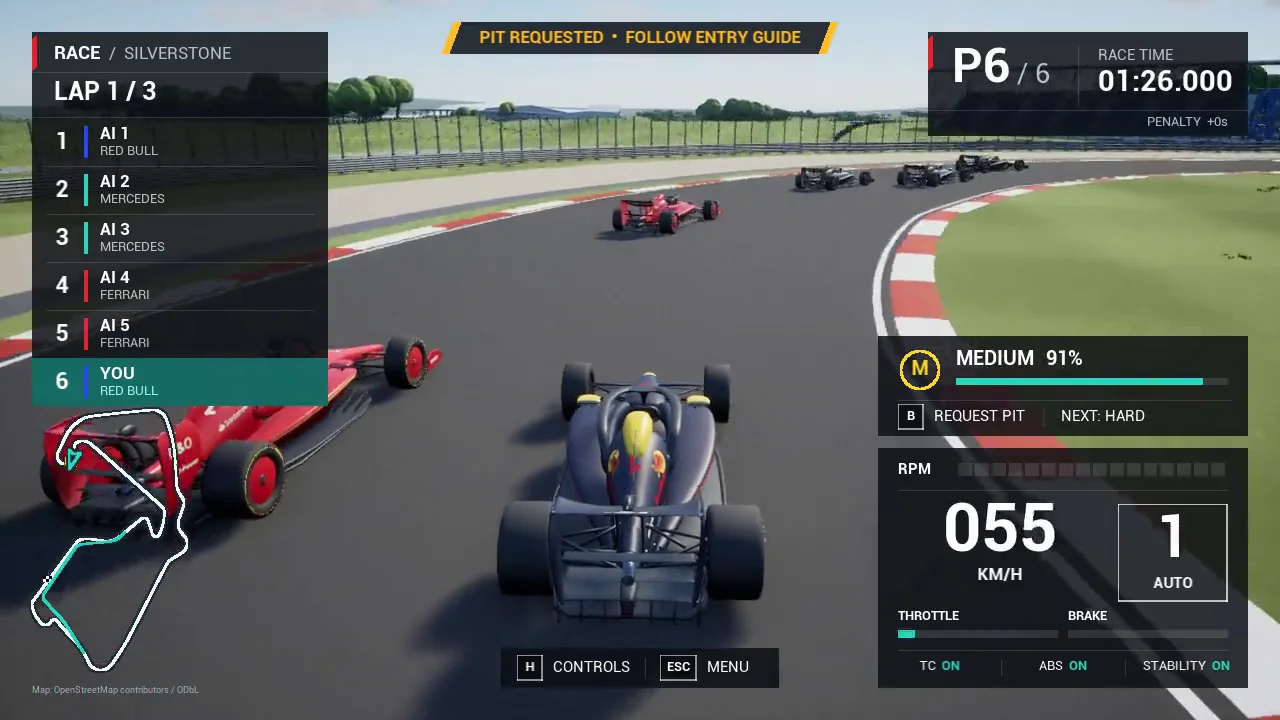
- –Race mode: six-car races where AI opponents use the same physics as the player, with five-light starts, ordered timing gates, track-limit penalties, DNF handling and results, plus a separate time-trial mode with saved personal bests
- –Pit stops and tires: Soft, Medium and Hard compounds with distance-based wear, a mandatory compound change, an 80 km/h limiter on the pit asphalt, and teammates queuing for a shared box
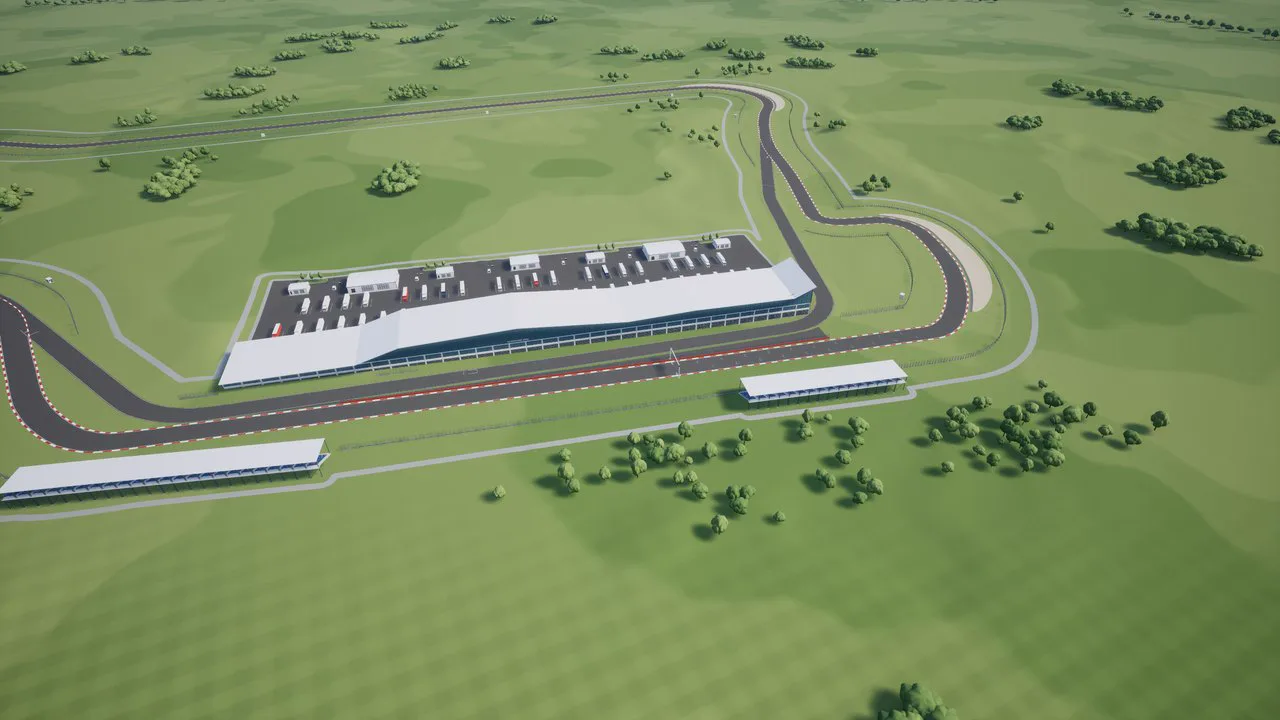
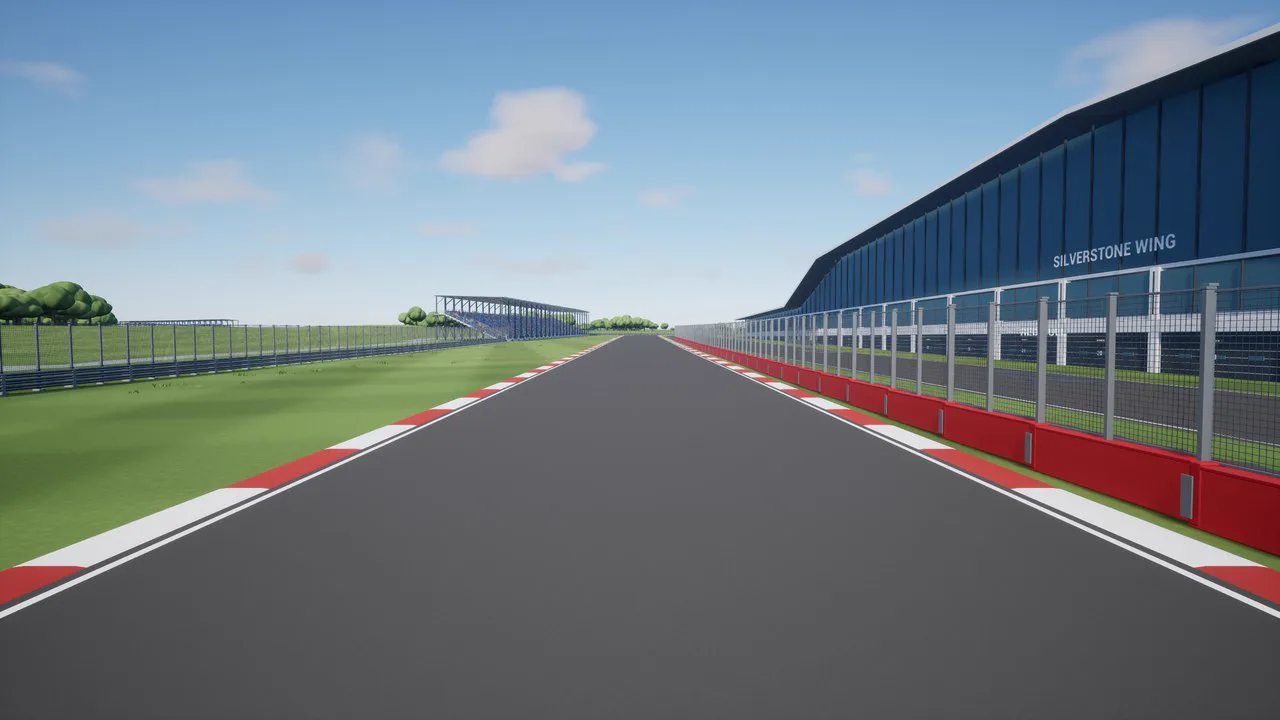
- –Silverstone from open data: the Grand Prix layout from OpenStreetMap with elevation sampled from 1 m LIDAR, plus kerbs, run-off and landmark buildings
- –Broadcast-style HUD and menus: standings, minimap with car markers, tire state, speed and RPM cluster and assist indicators drawn in C++, with Home, race setup and settings screens in Slate
- –Networked free drive: each machine simulates its own car and remote cars are Hermite-interpolated between 30 Hz state updates, with a procedurally synthesised engine and road audio mix
03 / Challenges
- –Keeping a handling model that feels forgiving on a keyboard while staying a real simulation, with wheels that can lock and spin and weight that transfers under braking and cornering
- –Making race progress hard to cheat: a lap counts only when every gate is crossed forward and in order, so a shortcut, a wrong-way crossing or a sudden jump cannot advance a car
- –Networking cars that each run their own physics at 240 Hz without visible jumps or input lag for the owner
- –Building a believable circuit from open geodata alone, where the source ways are partly estimates and the terrain survey predates the 2019 resurfacing
04 / Solution
The simulation core is a header-only C++17 model in SI units with no Unreal dependency, converted to engine units only at the pawn boundary, and the race and pit rules live in their own engine-independent headers. Standalone suites cover dynamics, controls, race rules, pits, time trial and networking. Multiplayer is owner-authoritative: each player's machine runs its own car exactly as in single-player, sends a quantised state about 30 times per second, and other clients render remote cars slightly behind real time with Hermite interpolation. The circuit comes from a data pipeline of Python scripts that turn OpenStreetMap and LIDAR into route, pit and landmark files, which an Unreal actor builds into the map.
05 / Outcome
A playable six-car race prototype with real tire strategy, assists and a broadcast-style HUD, released as open source under the MIT license. The game content (maps and meshes) is not in the public repository, so the C++ project compiles and the simulation tests run, but playing needs those assets. Multiplayer currently covers free drive only.
06 / Screens
01 / 02